Institutional early childhood upbringing and education in the digital age
Keywords:
Early childhood, early childhood educator, playing, competence, educationSynopsis
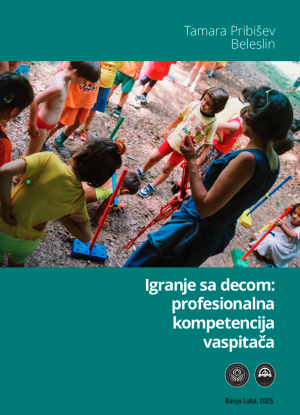
The scientific monograph Playing with Children: The Professional Competence of Preschool Teachers offers a theoretically grounded reflection on play as the key space of encounter between the teacher and the child. It traces the historical formation of ideas about childhood and play - from ancient societies and their understanding of the child, through the Enlightenment and Fröbel’s kindergarten, and up to contemporary concepts that view play as a culture of childhood, a mode of thinking, and a form of learning. A special emphasis is placed on distinguishing between play as an activity and playfulness as an adult personality trait, highlighting that the competence for playing with children does not equate to personal playfulness alone, but to a professional ability to build a safe and stimulating relationship through humor, rhythm, imagination, and communication. In the empirical part of the monograph, the experiences of preschool teachers are examined, including their definitions of play and their perceptions of their own role during play in the context of institutional early childhood education. The findings indicate that play competence consists of personal, theoretical, relational and reflective dimensions - ranging from spontaneity and empathy, through methodological knowledge, to the ability to design, observe and interpret play. In conclusion, play emerges as a bridge between the world of children and the world of adults: a space in which hierarchies are softened, collaboration is strengthened, and learning takes place, while the teacher becomes a partner and creator of a pedagogical culture founded on playfulness.
Downloads
Downloads
Published
License

This work is licensed under a Creative Commons Attribution-NonCommercial 4.0 International License.