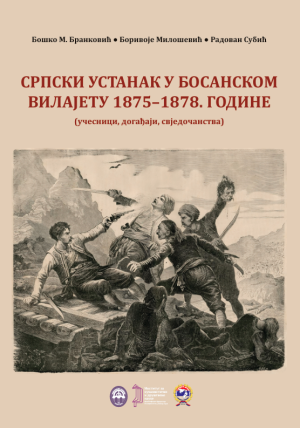
The Serbian Uprising in the Bosnia Eyalet 1875–1878 (Participants, Events, Testimonies)
Keywords:
Bosnian vilayet, Serbian uprising, personalities, events, testimoniesSynopsis
On the eve of the 1875 uprising, the position of the Serbian population in the Ottoman provinces of Herzegovina and Bosnia was exceedingly precarious. Feudal pressures had become intolerable, and the Christian peasantry suffered from both brutal economic exploitation and political marginalization. The state, replacing the former tithe, now demanded one-fifth of the harvest, while landowners, instead of the previous one-third, claimed half of the peasants’ produce. These conditions are corroborated by reports of Austro-Hungarian border guards, based on the testimonies of Serbian refugees from Ottoman territories. The reports indicated legal insecurity, inequality before the law between Christians and Muslims, widespread abuses in tax collection, and the persecution of Serbian clergy. The principal cause of the uprising, both in Herzegovina and in Bosnia, lay in the heightened socio-economic tensions of the period. The unsuccessful reforms of the nineteenth century drove the Ottoman Empire into an increasingly severe political and economic crisis. The Edict of Gülhane of 1839 encountered strong opposition from the Muslim population, while the attempt to regulate relations between the authorities and their subjects through the Hatt-i Hümayun of 1856 proved largely ineffective. This failure only served to intensify the resistance of Muslim feudal lords to centralizing reforms. In practice, each proclaimed reform remained largely a formality. The antagonism between feudal lords and serfs carried an ethno-religious dimension, and social divisions were accompanied by religious and national distinctions, thus imbuing the uprisings of the nineteenth century with a pronounced religious and national character of resistance. Sources addressing the outbreak of the uprising in Herzegovina and Bosnia in 1875 associate this event with the collection of the tithe and the peasants’ refusal to pay it. Social demands were soon overshadowed by political goals directed toward national liberation. The Serbian insurgents petitioned the Sultan for freedom of religion, the abolition of the kuluk and tithe levies, relief within the tax system, protection from the violence of local authorities and Muslim landowners, as well as equality before the law. The fate of the provinces of Bosnia and Herzegovina was determined at the Berlin Congress, held from 13 June to 13 July 1878. At the Congress, the Austro-Hungarian Monarchy was granted a mandate to occupy these Ottoman provinces. The decisions of the Berlin Congress represented a definitive defeat for the Serbian movement seeking the liberation and unification of Bosnia and Herzegovina with Serbia and Montenegro, although the latter were recognized at the Congress as independent states and granted significant territorial expansions.
Downloads
Downloads
Published
Categories
License

This work is licensed under a Creative Commons Attribution-NonCommercial-NoDerivatives 4.0 International License.