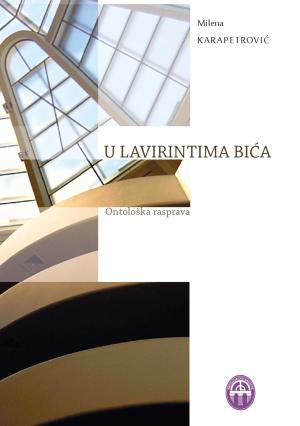
In the Labyrinths of Being. An Ontological Inquiry
Keywords:
ontology, phenomenology, fundamental ontology, hermeneutics, postmodern philosophySynopsis
The book In the Labyrinths of Being. An Ontological Inquiry is a philosophical overview and critical reflection on the development of ontology, its basic concepts, its relationship to metaphysics, and its place within contemporary philosophical thought. Five thematic units present a brief overview of the historical development of ontology, including the period before its establishment as a discipline. Key ontological questions from ancient philosophy, through the philosophical systems of Immanuel Kant, Georg Wilhelm Friedrich Hegel, Martin Heidegger and Edmund Husserl, to contemporary approaches in the 20th and 21st centuries are examined. The author reconsiders fundamental philosophical concepts - being, Being, and becoming - and their relevance in the contemporary context, emphasizing the importance of a new interpretation of language and a pluralistic approach.
The first chapter provides a historical overview of the concept of ontology, the framework within which this discipline is situated, and an outline of the relationship between ontology and metaphysics, along with an analysis of the division between continental and analytic philosophy. The second chapter examines Kant's critical philosophy and the question of whether progress in metaphysics is possible. The third chapter examines the distinction between philosophers who remain within the metaphysical-ontological tradition and those who turn toward an analytic approach to ontological problems. It also presents the main questions articulated in Hegel's dialectic and Heidegger's fundamental ontology, as well as the central problems addressed in Husserl's phenomenology and Nicolai Hartmann’s “new ontology.” The fourth chapter focuses on language, hermeneutics, and existence. Special emphasis is placed on the paradigm shift from essence-based to existence-oriented thought and on the importance of language and interpretation. The final chapter addresses postmodern and feminist perspectives. The plurality of perspectives, deconstruction, simulation, and the significance of feminist and gender debates in contemporary philosophy are examined.
Downloads
Downloads
Published
Categories
License

This work is licensed under a Creative Commons Attribution-NonCommercial-NoDerivatives 4.0 International License.