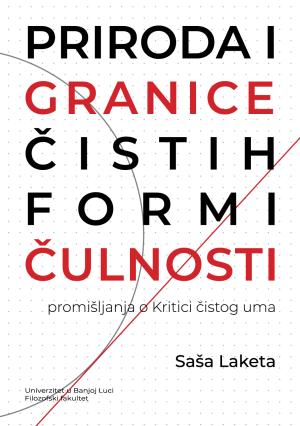
Nature and limits of the pure forms of sensibility: Reflections on the Critique of Pure Reason
Keywords:
Time, space, imagination, Kant, geometrySynopsis
The monograph examines the theoretical and epistemological presuppositions of Kant‘s critical philosophy, with a particular focus on the nature, functions, and limits of the pure forms of sensibility: space and time. The author seeks to demonstrate that Kant‘s transcendental approach cannot be considered exclusively from the perspective of the constructive role of the a priori forms of sensibility in grounding experience and knowledge, but that their limiting or negative aspects must also be investigated.
Particular attention is devoted to the relationship between the universal necessity of geometrical principles, on the one hand, and their precise application in experience, on the other, as well as to the attempt to reveal a circularity in certain of Kant‘s argumentative procedures. The author aims to connect analyses of space and time with fundamental questions concerning the possibility of objective knowledge, the relationship between thought and objectivity, and the limits of transcendental explanation. In this way, the study opens a space for a critical re-examination of certain assumptions of Kantian transcendentalism and for further research into the relationship between the a priori conditions of knowledge and individual objects of experience.
The author argues that Kant conflates two properties of geometrical knowledge: the universal necessity of the application of geometry to experience and its measurable precision. According to the author, universal necessity can be defended by appealing to a common transcendental root (space and time), whereas precision cannot be derived in this way, since it is empirical and a posteriori. Hence the claim that Kant‘s argument for the apodictic application of geometry to experience involves circular reasoning. Moreover, the distinction between the phenomenal and the noumenal does not affect the problem of precision, since imprecision is encountered in both cases.
The monograph also relates the distinction between judgments of perception and judgments of experience, the problem of temporal continuity, Husserl‘s double nature of the mind, and Heidegger‘s interpretation of transcendental imagination as the common root of sensibility and understanding.
Downloads
Downloads
Published
Categories
License

This work is licensed under a Creative Commons Attribution-NonCommercial 4.0 International License.