Agriculture and International Integrations
Keywords:
Agriculture, International Integration, Common Agricultural Policy (CAP), World Trade Organization (WTO), Western BalkansSynopsis
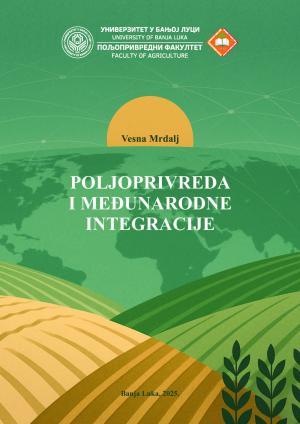
The aim of the monograph Agriculture and International Integration is to provide a comprehensive overview of the relationship between agriculture and international integration processes through an analysis of their economic, institutional, and developmental implications. Agriculture, as a sector of strategic importance, transcends national boundaries and becomes an integral part of the global and regional trade architecture, linking the economic, social, and environmental dimensions of sustainable development.
The subject of the research encompasses three groups of countries used to illustrate the process of integration: the countries of Western Europe, which laid the foundations of the Common Agricultural Policy (CAP) of the European Union; the countries of Central, Eastern, and Southeastern Europe, which underwent transition and EU accession; and the countries of the Western Balkans, which remain in the process of European and multilateral integration. This comparative analysis provides insight into different models of institutional reform, agricultural policy adjustment, and changes in the structure of agricultural support.
The monograph examines the development of agriculture within the framework of the General Agreement on Tariffs and Trade (GATT) and the World Trade Organization (WTO), as well as the institutional mechanisms of the European Union’s Common Agricultural Policy. Special attention is devoted to the role of agriculture in the context of the United Nations 2030 Agenda for Sustainable Development, the green transition, digitalization, and climate change.
It is concluded that international integration is not merely a process of trade liberalization but also an instrument of profound transformation of national policies, enhancement of competitiveness, and strengthening of sectoral sustainability. Agriculture thus stands out as a key factor in economic and social development, particularly in the Western Balkans, where integration processes represent the main framework for modernization, institutional strengthening, and balancing market principles with development objectives.
Downloads
Published
License

This work is licensed under a Creative Commons Attribution-NonCommercial-ShareAlike 4.0 International License.