ANNUAL FORAGE LEGUMES PEA, FABA BEAN AND LUPINES
Keywords:
forage legumes, pea, faba bean, lupines, utilizationSynopsis
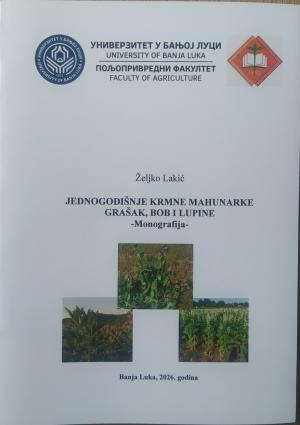
The monograph "Annual Forage Legumes: Pea, Faba Bean and Lupines" represents a publication that thoroughly addresses the cultivation and utilization of three significant, but in domestic agriculture unjustifiably neglected annual forage legumes. The monograph combines the results of the author's own multi-year scientific research work with the latest achievements from domestic and world literature, providing insight into the origin, biology, and production technology of these plant species.
The publication emphasizes the economic importance of these forage species in sustainable and regenerative agriculture, as well as their suitability for organic production and green manuring. The cultivation of winter forage legumes as intercrops, such as forage pea, favorably affects soil fertility, along with reducing the use of agrochemicals. Through botanical classification, subspecies and the purpose of varieties are defined. Within the framework of morphological and biological characteristics, their ability to fix nitrogen through symbiosis with nodule bacteria is presented. Their positive impact on the soil through the reduction of compaction and the increase of organic matter is analyzed in detail, as well as their role in the biological control of nematodes using alkaloids of bitter lupines. Also, the requirements of these annual forage legumes regarding agroecological conditions are addressed.
In the technological part, the complete agrotechnics is presented, which includes crop rotation, primary and presowing soil preparation, fertilization, optimal sowing dates, care, and crop protection against weeds, diseases, and pests. The subsection on utilization brings solutions for green forage production, preparation of haylage and silage in mixtures with small grains, as well as the possibilities of grain application in the food industry and alternative medicine, where faba bean grain serves as a supportive therapy in the treatment of Parkinson's disease, hypertension, kidney disorders, and liver cirrhosis. The process of mechanized harvesting is described through optimal dates and technical adjustments of combines to reduce losses and grain damage. Finally, the publication brings an insight into the yield and quality of forage and grain, and their nutritional value as a source of plant proteins and essential amino acids for livestock production.
Downloads
Downloads
Published
License

This work is licensed under a Creative Commons Attribution-NonCommercial-ShareAlike 4.0 International License.