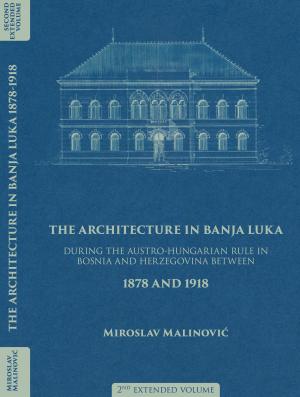
A MONOGRAPH: THE ARCHITECTURE IN BANJA LUKA DURING THE AUSTRO-HUNGARIAN RULE IN BOSNIA AND HERZEGOVINA BETWEEN 1878 AND 1918, 2nd extended volume
Keywords:
Banja Luka 1878-1918, Austro-Hungarian Empire, historic-revival styles, Bosnia and Herzegovina cultural and historical heritageSynopsis
Here you can find pdf of publication in very low resolution, to familiarize yourself with its content. If you want to have the book in printed form with full resolution of all images, you can contact the author by email: miroslav.malinovic@aggf.unibl.org.
This book comprehensively explores the architecture and urban development in Banja Luka during the Austro-Hungarian rule from 1878 to 1918. Following the Congress of Berlin in 1878, the introduction of Austro-Hungarian governance in Bosnia and Herzegovina brought significant changes to quality of life and the urban landscape. In Banja Luka, this era saw the implementation of numerous transformative projects, including the redevelopment of the urban matrix, the construction of various military, public, religious, educational, and industrial facilities, and the development of high-class residential areas, parks, green zones, and public spaces that shifted the city’s atmosphere towards a European character.
The book begins with a brief overview of the historical context, focusing primarily on the architectural production and urban development between 1878 and 1918. It highlights and analyses the most important buildings of the period, examining their historical and contemporary roles in city life and discussing the overarching significance of this era in shaping Banja Luka’s history. The work also explores key architects and architectural styles, including historicism, secession, and the „Bosnian style,“ relating these styles to specific buildings within the city. Additionally, the book touches on subsequent development phases, underscoring the lasting impact of the Austro-Hungarian period on the city’s overall growth.
The research draws on various sources, from 19th-century travelogues, yearbooks, and government reports to modern monographs and reviews on specific topics and buildings. Central to the study are original maps, photographs, postcards, and fieldwork findings, which comprise the book’s analysis and documentation of important buildings and urban structures.
The findings reveal that the buildings and urban routes established during the Austro-Hungarian period played a pivotal role in shaping the present-day image of Banja Luka. These structures continue to influence various aspects of life in the city, underscoring their enduring significance in the urban development narrative.
Downloads
Downloads
Published
Categories
License

This work is licensed under a Creative Commons Attribution-NonCommercial-NoDerivatives 4.0 International License.