From colonialism to digital capitalism: sociological theories of capitalist transformation
Keywords:
capitalism, imperialism, modernization, dependency, world-system, digital capitalism, platforms, surveillanceSynopsis
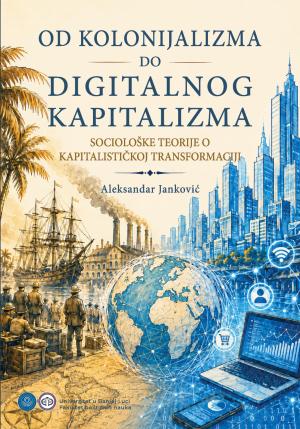
This monograph examines the historical development and successive transformations of capitalism through a critical engagement with major sociological traditions, ranging from classical theories of imperialism to contemporary accounts of informational, platform, and surveillance capitalism. Taking Marx’s analysis of the capitalist mode of production as its conceptual point of departure, the study understands capitalism as a historically mutable and exceptionally adaptive socioeconomic order whose underlying logic rests on capital accumulation, the production of surplus value, wage labor, and the private appropriation of socially produced wealth. Through a critical reconstruction of theories of imperialism, modernization, dependency, and the world-system, the monograph demonstrates that global inequality and the underdevelopment of peripheral societies are not temporary anomalies but structural consequences of capitalism’s historical expansion. Particular attention is devoted to the roles of the state, market coordination, corporate power, and technological change in the reproduction of capitalist relations. The analyses of informational, platform, and surveillance capitalism show that digital technologies do not constitute a rupture with earlier phases of capitalist development. Rather, they extend the frontiers of accumulation by transforming data, knowledge, communication, attention, and human behavior into economically exploitable resources. The monograph’s central argument is that capitalism endures through its capacity for institutional, spatial, and technological reconfiguration, while its foundational imperative remains unchanged: the ceaseless expansion of capital. Colonial exploitation of territories, industrial exploitation of labor, financial exploitation of indebted states, and digital extraction of data thus represent historically distinct yet structurally interconnected expressions of the same underlying logic of accumulation, power, and inequality production.
Downloads
Downloads
Published
License

This work is licensed under a Creative Commons Attribution-NonCommercial-NoDerivatives 4.0 International License.