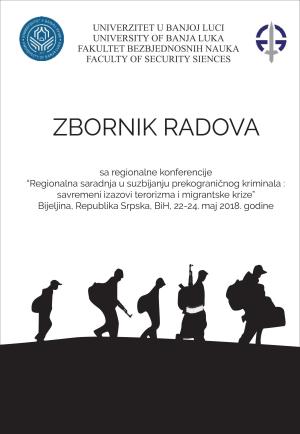
PROCEEDINGS OF THE REGIONAL CONFERENCE “Regional Cooperation in Combating Cross-Border Crime: Contemporary Challenges of Terrorism and the Migrant Crisis”, Bijeljina, Republic of Srpska, Bosnia and Herzegovina, 22–24 May 2018.
Keywords:
Terrorism, Migrant Crisis, Radicalization, Cross-Border Crime, Critical InfrastructureSynopsis
The proceedings presented before you were created as a result of a three-day regional conference titled “Regional Cooperation in Combating Cross-Border Crime: Contemporary Challenges of Terrorism and the Migrant Crisis”, held from 22 to 24 May 2018 in the ethno-village Stanišići near Bijeljina. The organizers of this scientific conference – the Criminal Police Academy in Belgrade, the Faculty of Security Sciences of the University of Banja Luka, and the Hans Seidel Foundation from Munich – through the selection of topics and speakers, sought to ensure that this would not be a conference of interest only to its organizers and participants, as it attracted significant media attention. Media interest in the event was considerable. Leading media outlets broadcast reports about the conference during prime-time news slots. A special tribute to the event was given by the presence of Željka Cvijanović, the President of the Government of the Republic of Srpska. In her address to the participants, President Cvijanović emphasized the importance of security challenges, risks, and threats posed by terrorism and the migrant crisis, which affect not only the Republic of Srpska and Bosnia and Herzegovina but also the entire region.
The work of the conference was organized into three sessions. The first session, titled “Terrorism, Radicalization and Violent Extremism”, provided a framework for papers focused on various aspects of terrorism and radicalization. In this context, topics were presented related to challenges within the institutional capacities of the Republic of Serbia in countering terrorism. Strategic approaches to this issue, recognized as one of the leading threats to national security in Serbia, were discussed. Experiences from Montenegro were also valuable. This was followed by topics addressing theoretical, conceptual, and practical issues of radicalization leading to terrorism. From the content of the first session, it can be concluded that terrorism and violent extremism are realities highly present in the Western Balkans, and that different national-level solutions are applied in addressing this problem. Furthermore, regarding terrorism in the Western Balkans, from the perspective of international relations, different and selective approaches can be observed.
During the session titled “Terrorism and the Migrant Crisis”, presenters discussed theoretical aspects of radicalization as well as proactive and reactive responses to terrorist threats. The role of the police and the training of police officers in countering terrorism were also addressed. The conclusions of the second session indicate that the concepts of radicalization and extremism require more thorough elaboration. It is particularly important to note the assessment that the approach to securing legal entities as potential terrorist targets – especially critical infrastructure – is not satisfactory, and that institutional capacities are inadequate. Therefore, a shift in approach to critical infrastructure protection is necessary, along with fundamental changes to improve measures and reduce risks. The focus of the second part of the session was on the migrant crisis, with the conclusion that the migration wave facing Bosnia and Herzegovina represents a serious security threat and that the country currently lacks the institutional capacities to adequately respond to it. Although the executive authorities have been adopting documents such as the Strategy of Bosnia and Herzegovina for the Prevention and Fight Against Terrorism since 2010, public policies in this area cannot be considered sufficiently recognizable.
Within the third session, papers were presented addressing the consequences of organized crime, illegal migration, and terrorism on the security of Bosnia and Herzegovina, as well as a paper in the field of forensic analysis of explosions. The use of explosive devices is a very common method of terrorist attacks, which attracted significant attention from conference participants.
Terrorism and migration are issues of regional importance and require serious cross-border cooperation. Even today, half a year later, the migrant crisis has not lost its relevance nor shown signs of ending. This gives additional value – the kind that only the passage of time can provide – to the discourse held in the spring in the ethno-village Stanišići.
Downloads